
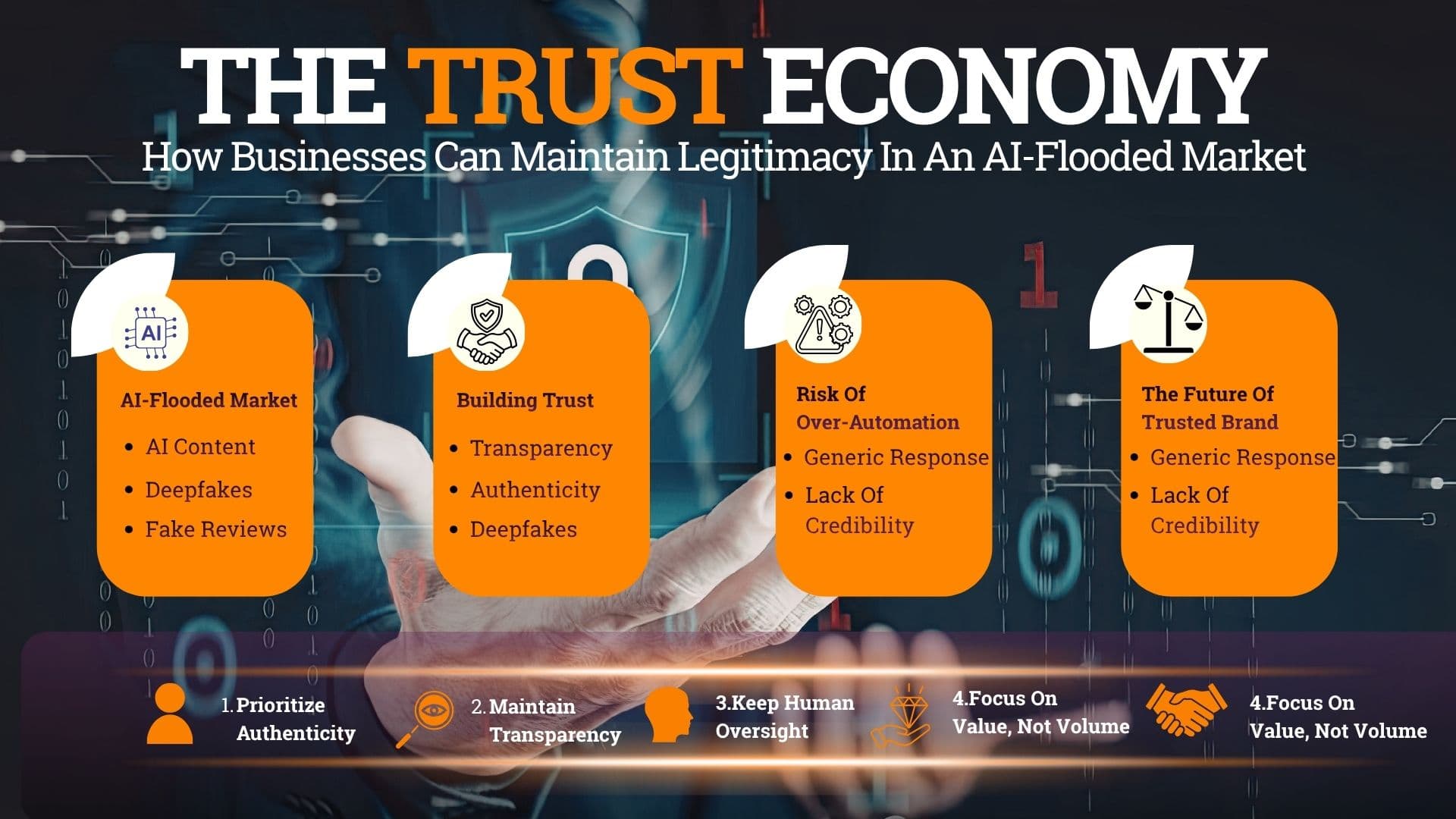
The Trust Economy
How Businesses Can Maintain Legitimacy in an AI-Flooded Market
Artificial Intelligence is reshaping how businesses create content, engage customers, and make decisions. Today, brands can generate blogs, social media posts, marketing campaigns, and even customer responses in seconds using AI tools.
This shift has unlocked remarkable efficiency. But it has also introduced a new challenge: trust.
When content can be produced instantly and at scale, customers are left asking a critical question: what and who can I believe?
Welcome to the Trust Economy, where credibility, transparency, and authenticity are the most valuable assets a business can hold.
The Rise of the AI-Flooded Market
AI has significantly lowered the barrier to content creation. Businesses can now produce large volumes of marketing material faster than ever.
The result is a saturated digital environment filled with automated content.
Customers are increasingly encountering:
- AI-generated articles and blogs
- Automated customer service responses
- Synthetic product reviews
- Deepfakes and manipulated media
- Mass-produced marketing campaigns
This saturation is changing behavior. Consumers are becoming more skeptical, asking tougher questions about the source and reliability of information.
That shift is forcing brands to rethink how they communicate.
Why Trust Is the Ultimate Competitive Advantage
In a landscape where content is abundant, trust becomes the real differentiator.
Customers are not just looking for information. They are looking for signals that feel real and reliable:
- Transparency in processes and technology
- Consistency in brand voice and values
- Clear human expertise behind messaging
- Genuine customer experiences and testimonials
- Ethical use of technology
Brands that demonstrate these signals stand out. The reality is simple: people trust people more than algorithms.
The Risk of Over-Automation
AI can scale operations, but over-reliance on automation can weaken credibility.
When interactions feel generic or robotic, customers start questioning whether there is a real brand behind the message.
Common warning signs include:
- Messaging that lacks personality
- Unverified AI-generated content
- Automated responses that miss real customer concerns
- No clarity on how information is created
Over time, these patterns erode trust. Efficiency alone is not enough. Businesses need balance.
Transparency as a Trust Signal
Transparency is quickly becoming one of the strongest indicators of credibility.
Brands that openly communicate how they use AI tend to build stronger trust than those that hide it.
This can take several forms:
- Acknowledging when AI tools are used
- Maintaining human oversight
- Verifying information before publishing
- Upholding clear ethical standards
Here’s what matters. Customers value honesty. Transparency shows accountability.
Human Expertise Still Matters
AI is powerful, but it does not replace human judgment.
It can assist with research, analysis, and content creation. It cannot replicate lived experience, critical thinking, or professional insight.
The strongest approach is a hybrid one. Use AI to increase efficiency, while relying on human expertise to ensure credibility.
Building Trust in the AI Era
To stay credible in this evolving landscape, businesses should focus on a few core principles:
1. Prioritize authenticity
Let your brand voice reflect real people and real values.
2. Maintain transparency
Be clear about how technology supports your work.
3. Keep human oversight
AI should support decisions, not replace them.
4. Focus on value, not volume
Quality will always outperform mass production.
5. Strengthen customer relationships
Engagement, responsiveness, and accountability build lasting trust.
The Future Belongs to Trusted Brands
AI will continue to evolve, giving businesses more powerful tools than ever.
But technology alone will not define success.
In a world where content is instant, trust becomes the most valuable asset a brand can build. Companies that prioritize credibility, transparency, and authentic engagement will not just compete. They will lead.
Join the conversation
Comments
Share your thoughts below. Comments are reviewed before appearing on the article.
No comments yet.
Be the first to share your perspective on this post.